Article
AEO for medical practices
A practical guide to making a medical practice’s information clear, trustworthy, current, and discoverable in search and AI answers.
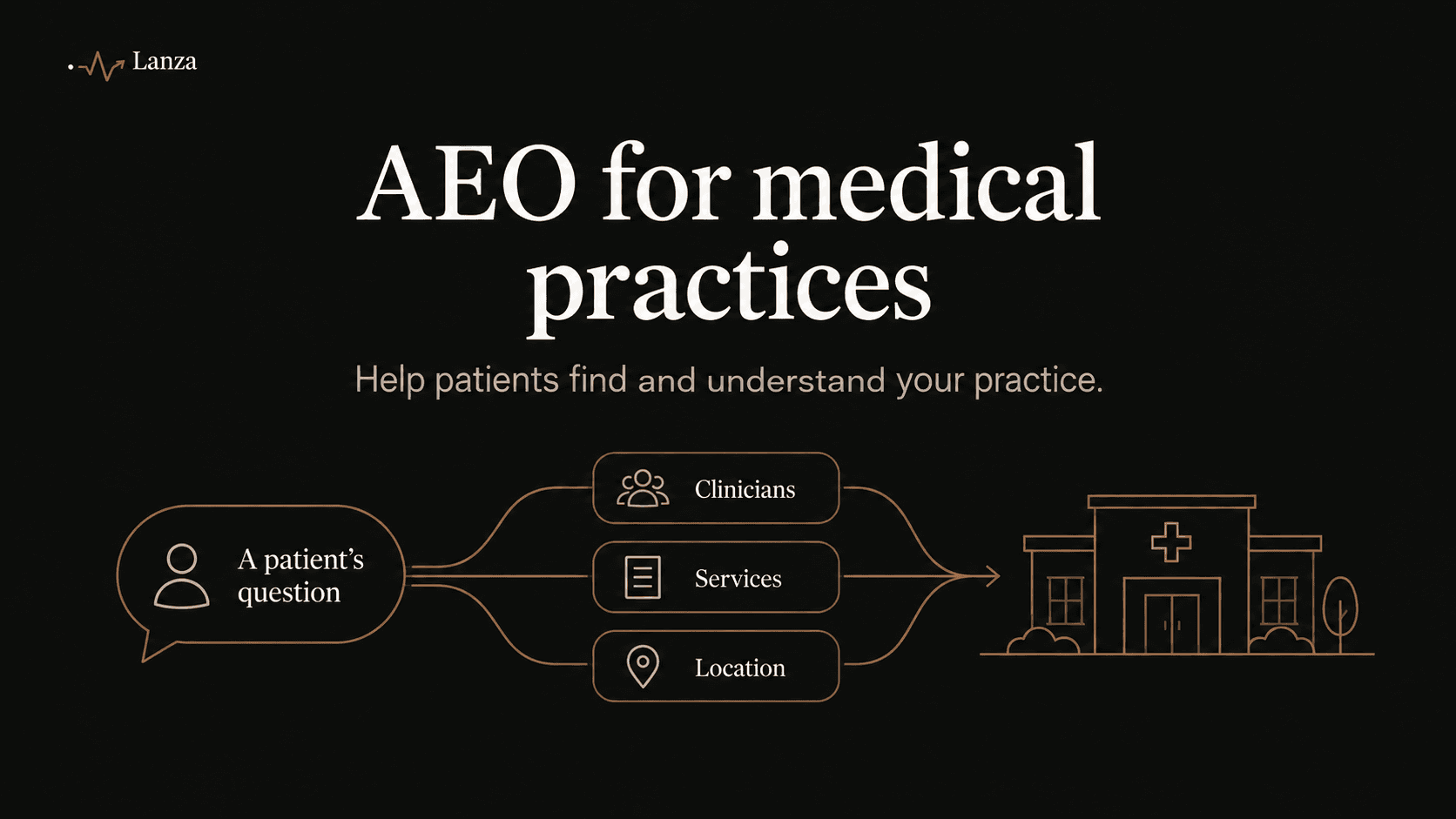
A medical practice can publish a new blog post every week and still make one basic question difficult to answer:
“Is this the right place for me?”
The answer may be obvious to the doctor or front desk. It can be much harder to find on the practice’s website.
That is where I would start with AEO. Before buying another visibility tool or commissioning twenty articles, make it easier to understand who the practice helps, what it offers and how a patient can take the next step.
Patients are asking questions in complete sentences:
- “Who treats persistent knee pain near me?”
- “Which primary care practices accept my insurance and offer same-week appointments?”
- “What should I ask before starting physical therapy?”
- “Is there a women’s health practice in my area that sees patients with this concern?”
Those questions do not map neatly to one keyword or one service page. An answer may combine clinical guidance, location, availability, reputation, and evidence that the practice actually does what it claims.
That is what answer engine optimization (AEO) means for a medical practice: making the right information clear, trustworthy, current, and discoverable wherever patients and the systems helping them look for care.
It is not a separate trick that replaces search optimization. Google says its AI features use the same foundational SEO requirements as other search results and do not require special AI markup or “AI files.” The practical work is to publish useful content, keep the site accessible, and make the practice’s real-world identity consistent. Google Search Central: AI features and your website
The patient question is larger than the keyword
When someone asks an assistant for a recommendation, the system may need to resolve several smaller questions before it can answer responsibly:
What kind of care is relevant? Is the person looking for education, an evaluation, a procedure, or ongoing management? Which practices offer it? Where are they located? What does the practice say about its approach? Is the information recent? Does a clinician or credible organization support the explanation?
You do not need a page for every variation. Google warns against pages for every imagined query or formulaic text. Cover real questions with original, clinically reviewed information that stands on its own. Google’s guidance on optimizing for generative AI features
For a practice, start with conversations at the front desk and in the exam room. What do patients misunderstand before booking? Which questions make staff repeat the same explanation? What helps a patient decide whether to call?
Start with a visibility and trust audit
Before publishing more, ask what a patient or assistant can learn about the practice in five minutes.
Check the practice’s name, address, phone number, hours, services, clinicians, insurance information, and appointment path. Compare the website with the Google Business Profile, major directories, insurer listings, and social profiles. If the name is abbreviated in one place, the address is outdated in another, or a service appears on one profile but not the website, fix that first.
Google says local results are mainly shaped by relevance, distance, and prominence. Complete and accurate business information helps it understand relevance; reviews, links, and mentions contribute to prominence. That does not mean a practice can manufacture a ranking. It means the basic identity and evidence around the practice should agree. Google Business Profile: Tips to improve your local ranking
Then search the questions a new patient would ask. Use the practice name, the service, the city, and nearby neighborhoods. Look at ordinary search results and the answers produced by the AI tools your audience uses. Record:
- which questions mention the practice;
- which questions mention a competitor instead;
- which sources are cited or linked;
- what facts are missing or wrong;
- whether the answer makes the next step obvious.
Treat these observations as a sample, not a permanent ranking. Answers change by location, time, wording, and user context. A mention is useful evidence that the practice is entering a conversation. It is not proof that the answer is medically appropriate or that the patient will book.
Build five layers of useful evidence
1. Make the practice legible
Every important page should answer quickly: who is this practice for, what does it provide, where is it, and how can someone start?
Use the real practice name and the names of real clinicians. Give each location its own accurate information. Explain services in the language patients use, while preserving the clinical meaning. Include accepted insurance only when the practice can keep it current.
Structured data can help Google interpret a local business’s name, location, hours and other details. It must match what is visibly true; schema cannot fix contradictory information. Google: Local business structured data
2. Turn recurring questions into reviewed answers
Choose five to ten questions that appear repeatedly in calls, visits, or appointment requests. Write the answer first. Then add the explanation, limitations, and next step.
For example, a practice that sees patients with persistent knee pain might explain what to bring to an evaluation, what symptoms warrant prompt medical attention, and what an appointment can assess. It should not promise a diagnosis from a webpage or imply that one treatment fits everyone.
Each answer should have:
- a clear question as the heading;
- a direct answer in the opening paragraph;
- plain explanations of relevant terms;
- the clinician or practice responsible for review;
- a visible publication or review date;
- links to authoritative medical sources where appropriate;
- a clear path to contact the practice.
Health information is a high-trust category. Google asks creators to make clear who produced content, how it was made, and why it is useful. MedlinePlus recommends checking who runs a health website, its purpose, evidence, and currency. MedlinePlus: Evaluating health information
3. Connect education to the actual service
An educational page should help a patient understand whether the practice is relevant, without turning clinical information into a sales script.
After answering a question about evaluation, explain what the practice’s evaluation includes. After explaining a treatment category, describe the services offered, who provides them, and what to expect before scheduling.
This is where many practices become generic. “We provide comprehensive care” tells a patient almost nothing. “At the first visit, the clinician reviews your symptoms, prior imaging, current medications, and goals before discussing next steps” is specific and useful if it is true.
4. Earn mentions that add context
Your website is only one part of the evidence an answer engine can find. Relevant third-party sources can help patients understand the practice in context: a local hospital directory, a professional association, a community resource, a clinician interview, or a genuinely useful contribution to a local discussion.
Avoid fabricated mentions, promotional forum flooding and reviews from people who did not receive care. Google warns against pursuing inauthentic mentions. Seek sources that can accurately explain what the practice does. Google’s AI optimization guidance
The same principle applies to clinician profiles and professional bios. A clinician’s expertise should be described consistently across the practice site, licensing or professional profiles, and relevant directories. Consistency gives patients a clearer basis for trust.
5. Keep the technical path open and measurable
Make sure important pages can be crawled, load without requiring an interaction that a search system cannot complete, and do not hide the core answer inside an image or an empty script shell. Review robots.txt, indexing controls, redirects, canonical URLs, sitemap coverage, and mobile rendering.
If the practice uses a CDN or security product, check its bot settings deliberately. OpenAI distinguishes its search crawler, OAI-SearchBot, from GPTBot, which is used for model training. A practice should decide which access it wants based on its own policy and verify that the technical setting matches that decision. OpenAI: Crawling and bots
Measurement needs the same care. Track search impressions and clicks in Search Console, organic and AI referral traffic in analytics, calls and appointment requests, and a simple “How did you hear about us?” question. Keep patient information out of marketing events. Do not send names, free-text symptoms, form contents, or appointment details to an analytics platform just to improve attribution. HHS says HIPAA obligations can apply when tracking technologies collect or disclose protected health information. Patient portals and appointment flows need particular care. Have the practice’s privacy and compliance owners review the implementation. HHS: Online tracking technologies
A 30-day plan for a practice
Days 1–5: establish the facts. Confirm the practice name, locations, hours, phone numbers, services, clinicians, insurance details, and booking path across the website, Google Business Profile, and major directories. Fix the highest-risk conflicts. Add clear clinician authorship and review dates to existing health content.
Days 6–10: collect patient language. Ask front-desk staff for recurring questions. Collect the questions staff hear repeatedly, without patient records or identifying details. Group them by service, concern, and decision stage. Do not copy patient narratives or identifying details into a public draft.
Days 11–20: publish the first answer set. Create five focused answers. Put the bottom line first, use one idea per paragraph, link to strong medical sources, and explain what the practice can actually do. Have the appropriate clinician review every clinical claim before publishing.
Days 21–25: strengthen the local evidence. Review clinician and location profiles. Correct mismatches. Ask legitimate partners and professional organizations to update their information where it is inaccurate. Create one useful educational video or clinician explanation if the team can maintain it; reuse the same clear answer across the practice site and the channel where patients already look.
Days 26–30: measure and choose the next gap. Record which questions produced impressions, clicks, calls, appointment requests, and self-reported AI discovery. Sample answers again from a few locations and phrasings. Refresh the page that is attracting attention but failing to help patients take the next step. Then choose the next five questions from observed demand.
What success should mean
Do not define AEO success as “the model cited us once.” A citation can be wrong, disconnected from a booking decision, or based on a page that no longer reflects the practice.
Look for a chain of evidence:
The practice appears for relevant questions. The answer describes the practice accurately. A patient reaches the site or calls. The patient understands what the practice does and what to do next. The practice can connect that interest to a qualified appointment without exposing private health information.
Review whether the people the practice is equipped to serve can understand its services and take the next step. A crawler visit alone does not establish that a page was cited, and an AI mention alone does not establish a new patient.
At Lanza, our bet is that this work becomes more useful when someone owns it every week. Lanza works as a practice’s AI marketing employee: it learns the practice, researches patient demand, prepares work in its voice and improves the next plan from what people respond to. The doctor reviews clinical content; the practice controls what goes live.
Start with five questions your staff already know how to answer. Make those answers clear, clinically reviewed and easy to find. Then use the response to decide what to improve next.